Designing a Custom 3D Coffee Pod Holder with Laser Cut Files
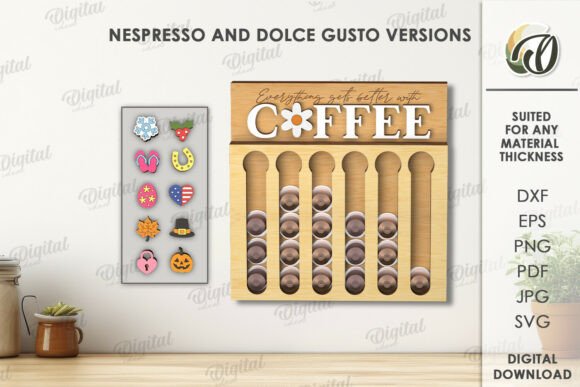
Organizing coffee supplies is often an afterthought in kitchen design, yet the clutter of single-serve pods can quickly overwhelm counter space. For makers, hobbyists, and DIY enthusiasts, the solution lies not in purchasing mass-produced plastic organizers, but in creating custom storage that fits specific aesthetic and spatial needs. This is where a 3D Coffee Pod Holder Laser Cut design becomes an invaluable resource. It is important to clarify immediately that this offering is a digital product. No physical goods will be sent. The photos provided are intended only for inspiration, showcasing what is possible when the digital files are applied to physical materials.
When you purchase this item, you receive a zip folder containing one versatile design in multiple file formats: SVG, DXF, EPS, PDF, JPEG, and PNG. This multi-format approach ensures compatibility with a wide range of cutting machines and software, making it a flexible tool for both beginners and experienced fabricators. Understanding the distinction between buying a finished product and acquiring a digital design file is crucial for setting the right expectations and maximizing the value of your purchase.
Understanding the Digital Nature of the Product
The primary advantage of acquiring a 3D Coffee Pod Holder Laser Cut file rather than a pre-made holder is control. When you buy a physical organizer, you are limited to the manufacturer’s choice of material, color, dimensions, and structural integrity. With a digital file, you become the manufacturer. You decide whether the holder is crafted from warm bamboo, sleek acrylic, sturdy plywood, or even recycled cardboard. This level of customization allows the final piece to integrate seamlessly into your home or office decor, rather than standing out as a generic utility item.
However, this freedom comes with responsibility. The user must have access to a laser cutter or a service that provides laser cutting. The files provided—SVG, DXF, and EPS—are vector-based, meaning they use mathematical paths to define shapes. This ensures that the design can be scaled up or down without losing quality, a critical feature for adjusting the holder to fit different pod sizes or countertop constraints. The inclusion of PDF, JPEG, and PNG formats serves as a reference for manual verification or for users who may need to trace designs for alternative cutting methods, though vector files remain the standard for precision laser cutting.
Comparing Laser Cutting to 3D Printing and Traditional Woodworking
When evaluating methods to create custom storage, three primary approaches emerge: laser cutting, 3D printing, and traditional woodworking. Each has distinct tradeoffs regarding time, cost, and aesthetic outcome.
- Laser Cutting: This method is ideal for creating layered, geometric structures. A 3D Coffee Pod Holder Laser Cut design typically relies on interlocking tabs and slots, eliminating the need for adhesives or complex joinery. The process is fast; once the file is loaded, cutting thin sheets of wood or acrylic takes minutes. The finish is clean and precise, with a modern, architectural look. However, it requires flat sheet materials and may show charring on certain woods if settings are not optimized.
- 3D Printing: While 3D printing allows for complex organic shapes and internal structures that laser cutting cannot achieve, it is significantly slower. Printing a holder of similar capacity could take hours rather than minutes. Additionally, 3D printed parts often require post-processing to remove support structures and smooth layer lines. For a simple grid-like storage solution, 3D printing may be overkill in terms of time and material waste.
- Traditional Woodworking: Hand-cutting or using a table saw offers robust durability and classic aesthetics. However, creating identical slots for dozens of coffee pods requires high precision and significant skill. The margin for error is small, and the time investment is substantial. Laser cutting democratizes this precision, allowing anyone with a basic understanding of the machine to produce professional-grade results.
For most users seeking a balance between speed, precision, and visual appeal, laser cutting offers the most efficient pathway. The 3D Coffee Pod Holder Laser Cut files are designed specifically to leverage the strengths of this technology, utilizing kerf-fit joints that hold together securely without glue.
Material Selection and Structural Considerations
Since the physical output depends entirely on the user’s choices, material selection is a critical decision factor. The design included in the zip folder is optimized for specific thicknesses, commonly 3mm or 1/8 inch materials, but this can vary. Using material that is too thin may result in a fragile structure that wobbles under the weight of filled pods. Conversely, material that is too thick may not fit into the pre-designed slots, requiring manual sanding or file adjustment.
Common materials include:
- Plywood: Affordable and widely available. Birch plywood offers a clean, light appearance that stains well. It is strong enough to hold a full load of coffee pods but may have visible layers on the edges.
- Acrylic: Provides a modern, transparent look that can make a small kitchen feel less cluttered. It is easy to clean but can scratch easily and may be more brittle than wood.
- MDF: Offers a smooth, uniform surface without grain patterns. It cuts cleanly but is heavier and does not handle moisture well, which is a consideration in a kitchen environment near coffee machines.
It is essential to test-fit a single unit before cutting the entire design. Laser cutters can vary slightly in their beam width, known as kerf. Adjusting the design scale by a fraction of a percent in your software can ensure a snug fit for your specific machine and material combination.
Practical Use Cases and Limitations
A 3D Coffee Pod Holder Laser Cut is an excellent solution for creating an original design for your home or office. The possibilities of creation are endless. You might create a compact version for a small apartment counter, a large modular system for an office breakroom, or even a wall-mounted rack to free up surface area. The modular nature of many laser-cut designs allows you to combine multiple units if your coffee consumption grows.
However, there are limitations to consider. Laser-cut holders are generally static; they do not offer moving parts or dispensing mechanisms unless specifically designed with complex hinges, which this basic design may not include. They are best suited for storage rather than active dispensing. Additionally, while the design is robust, it is not indestructible. Dropping a fully loaded wooden holder could cause joints to separate, though they can usually be reassembled easily.
This product is not suitable for individuals who do not have access to a laser cutter and are unwilling to use a third-party cutting service. If you are looking for an immediate, ready-to-use solution without any assembly or fabrication effort, purchasing a pre-made plastic organizer from a retail store would be more appropriate. This digital product is tailored for those who value the process of creation and the satisfaction of a bespoke result.
Making the Right Choice for Your Workspace
Deciding whether to utilize these digital files depends on your priorities. If you value uniqueness, material quality, and the ability to repair or modify your storage solution, then investing in a 3D Coffee Pod Holder Laser Cut design is a wise choice. It transforms a mundane organizational task into a creative project. The ability to choose eco-friendly materials like bamboo or reclaimed wood also aligns with sustainable living practices, reducing reliance on single-use plastics often found in commercial organizers.
On the other hand, if you lack the tools, time, or interest in fabrication, the learning curve may outweigh the benefits. In such cases, exploring ready-made alternatives might be more practical. But for the maker community, these files represent a high-value asset. They save the hours required to design a structurally sound, aesthetically pleasing holder from scratch, allowing you to focus on fabrication and finishing.
Thank you for visiting my store. Please write me a message if you have a question about file compatibility, material recommendations, or scaling adjustments. Happy shopping, and enjoy the process of bringing your custom coffee station to life.